Thing-sona
A card-based tool for exploring how we relate to technology—through roles, qualities, and the situations that shape them.
Research framing, physical card and board design, and interactive prototype development.
- Origin: Doctoral research on co-driving experiences
- Outputs: Physical toolkit and interactive web prototype
From experience to idea
A driving alert can feel like a helpful companion—or an irritating interruption. Describing its function alone misses how someone experiences the relationship.
Thing-sona grew from interviews with 12 non-professional drivers in China and Italy, within my co-driving research. Their accounts suggested a vocabulary of roles and qualities: the same lane-departure warning could be understood as a Helper or a Fuss.
The design question became: how can people express these relationships in their own terms? Persona thinking and the adjective–noun title combinations in Splatoon 3 inspired a simple pairing mechanism, grounded in a person’s situation rather than a technology’s supposed personality.
A language of Who + How
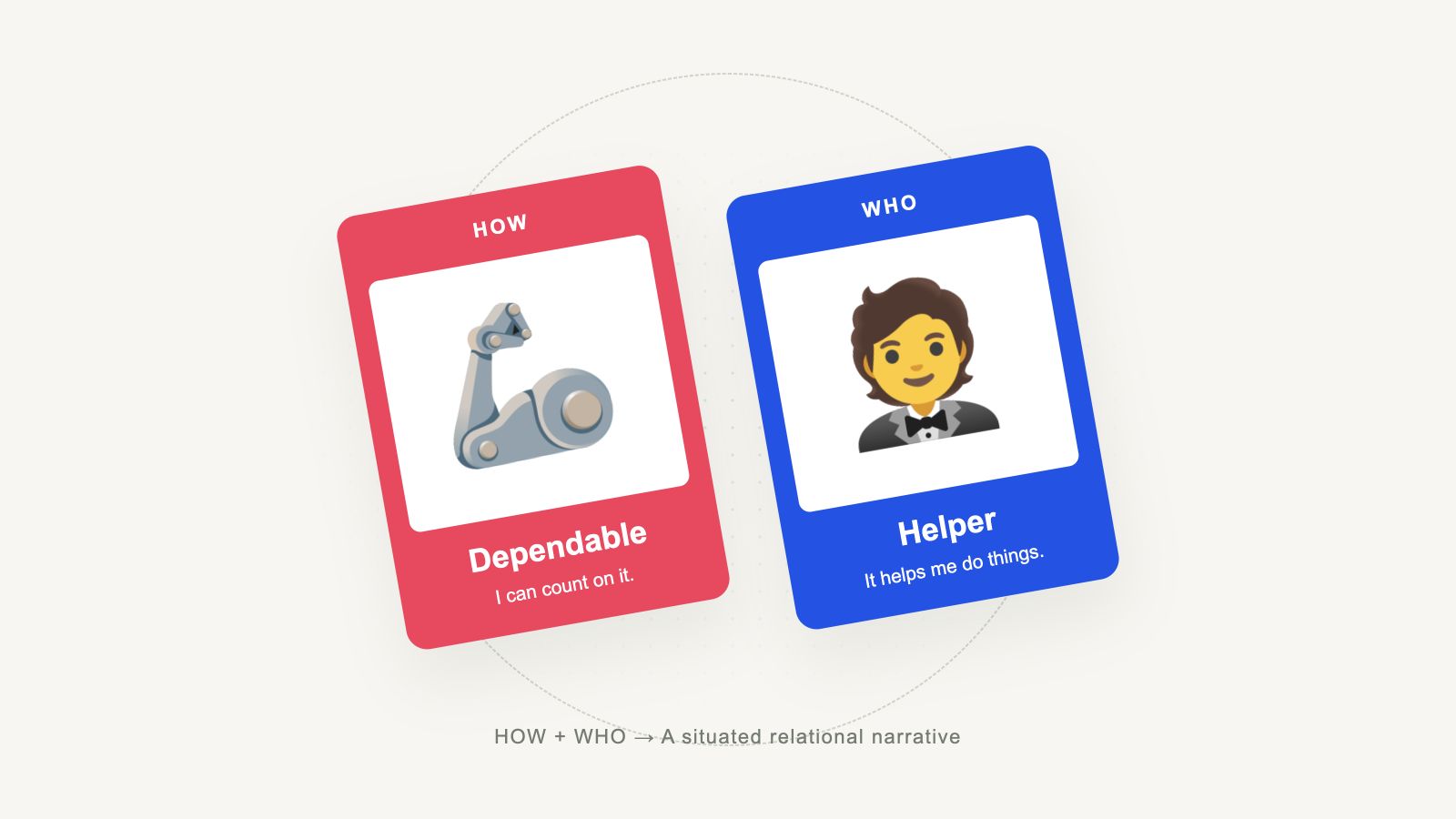
The toolkit combines two decks: blue Who cards suggest a perceived role; red How cards describe its quality. A pairing becomes the beginning of a story, not a fixed classification.
For example, Dependent + Secretary invites someone to explain what they rely on and why. The meaning can change with the person, technology, or situation. Blank cards keep that vocabulary open: participants can draw and name a relation that the existing deck does not capture.
Participants extend the vocabulary
Put the relationship in context
The board connects each pairing to a technology, a person, and a situation. Separate areas for expectations and experience help make differences discussable.
Situate → Pair → Compare → Reflect. Describe what matters, choose Who and How cards, and add a short explanation. The goal is a conversation about the relation—not a score for the technology.
The web prototype carries this process into an editable workspace, with searchable cards, custom-card creation, and project export/import.
In that example, a writer expects a Dependable Helper but experiences an Opinionated Substitute. The contrast opens a question: when does assistance support a person’s voice, and when does it displace it?
What this opens up
Early discussions with nine automotive design practitioners suggested value for inquiry and concept positioning, while raising questions about fitting the toolkit into existing workflows. These were preliminary impressions of the early toolkit, not a validation of the current web prototype.
Thing-sona offers a way to make relationships discussable. The next step is to understand how people reinterpret its vocabulary across technologies and design situations.
Sources and credits
Based on Peng Lu’s unpublished Thing-sona manuscript and concept slides. The 12 interviews informed the vocabulary; they were not a usability test. Physical toolkit and interview photographs: the author. Cover: an original composition using the prototype’s Dependable and Helper artwork; the physical deck uses Reliable for the corresponding card. Card illustrations: Noto Emoji, Apache-2.0. Web screenshot: live v0.3.10 prototype.