Future Mobility Design Workshop
Remote teaching assistance at Shandong University, helping final-year design students connect systemic inquiry, speculative futures and iterative proposals for automated public mobility.
Teaching Assistant / Workshop Co-facilitator: supported remote delivery, supervised student teams through research and concept development, and provided formative feedback in tutorials, interim reviews and final presentations.
- Institution: Shandong University · final-year undergraduate Product Design
- Delivery: Remote project-based workshops, 2022–2023
- Documented 2022 cohort: 28 students across six teams
- Focus: System understanding → future scenarios → iterative design and reflection
Teaching beyond the vehicle
What changes when a shuttle bus no longer needs a driver? For design students, the answer can quickly become a new vehicle shape or another screen. The teaching challenge was to widen that frame: who participates in this mobility system, what connects them, and whose needs might a proposed future overlook?
Across 2022–2023, I supported remote, project-based teaching within a final-year Product Design course at Shandong University. The workshops combined systemic and speculative design to help students move from understanding an existing system to proposing alternative futures for automated public mobility.
My role was Teaching Assistant and Workshop Co-facilitator, rather than sole course instructor. I supported the delivery of methods, supervised teams during research and concept development, and provided formative feedback on their reasoning, concept coherence and final communication. The framework was developed and applied by the teaching team; the design proposals shown here are student work.
The examples and cohort figures below document the 2022 workshop round, subsequently discussed in two 2023 publications. They are not a combined headcount for both years.
A shared scaffold, not a prescribed solution
The pedagogical intention was to build system understanding before solution-making, connect imagination to stakeholder relationships, and make reflection part of the design process rather than only a final report.
The documented round ran from 21 September to 30 October 2022. Twenty-eight students worked in six teams across three parallel strands: vehicle interior, exterior interaction and the station. Each strand explored nearer- and longer-term futures, giving students a common process without requiring the same answer.
Understand the system
Background research, role exploration and gigamapping made actors, technologies and relationships visible before students committed to a design direction.
Construct a future
Worldviews, scenarios and backcasting encouraged students to connect an imagined situation to its assumptions and implications.
Develop and reconsider
Concept libraries, selection and reviews turned broad visions into proposals that could be discussed, challenged and revised.
For remote delivery, explicit milestones and structured feedback helped connect these stages. My contribution was to support students in carrying earlier findings forward, rather than treating each method as an isolated exercise.
Making relationships visible before imagining solutions
Students began by exploring perspectives beyond their own: passengers, service staff, people facing travel barriers, pedestrians and pets. Role-playing was used to temporarily step outside the designer’s position; maps then made the relationships between those perspectives discussable.
The mapping exercise was not simply a list of users. It asked students to consider how a service, technology or design decision changes another actor’s experience. In tutorials and reviews, I supported teams in making these connections explicit and strengthening the rationale behind their concepts.
These artefacts also gave us a shared reference in remote discussion: relationships that were visible on a map could be revisited when a later proposal became disconnected from the original investigation.
Imagining futures—and questioning their assumptions
Near-term foresight and longer-term speculation created different design demands. The horizons below are relative to the original workshop, not forecasts made today.
Nearer future · around +5 years
Students worked with recognisable technologies and current practices. The station-focused paper expands this horizon to 5–10 years. The challenge was to distinguish a plausible development from an unsupported technological leap.
Distant future · around +50 years
Students could explore more radical social and technological change. The challenge was not to predict the future, but to examine what their imagined world assumed, enabled or excluded.
Backcasting connected the imagined situation to the present and helped reframe the problem. Teams then created concept libraries before selecting ideas for further development, sharing proposals and revising them through feedback.
The educational value lies in the transition from “we can imagine this” to “we can explain why this proposal belongs in this scenario.” My formative feedback focused on that coherence, the design rationale and the clarity of its communication.
Student work: the station as a connected place
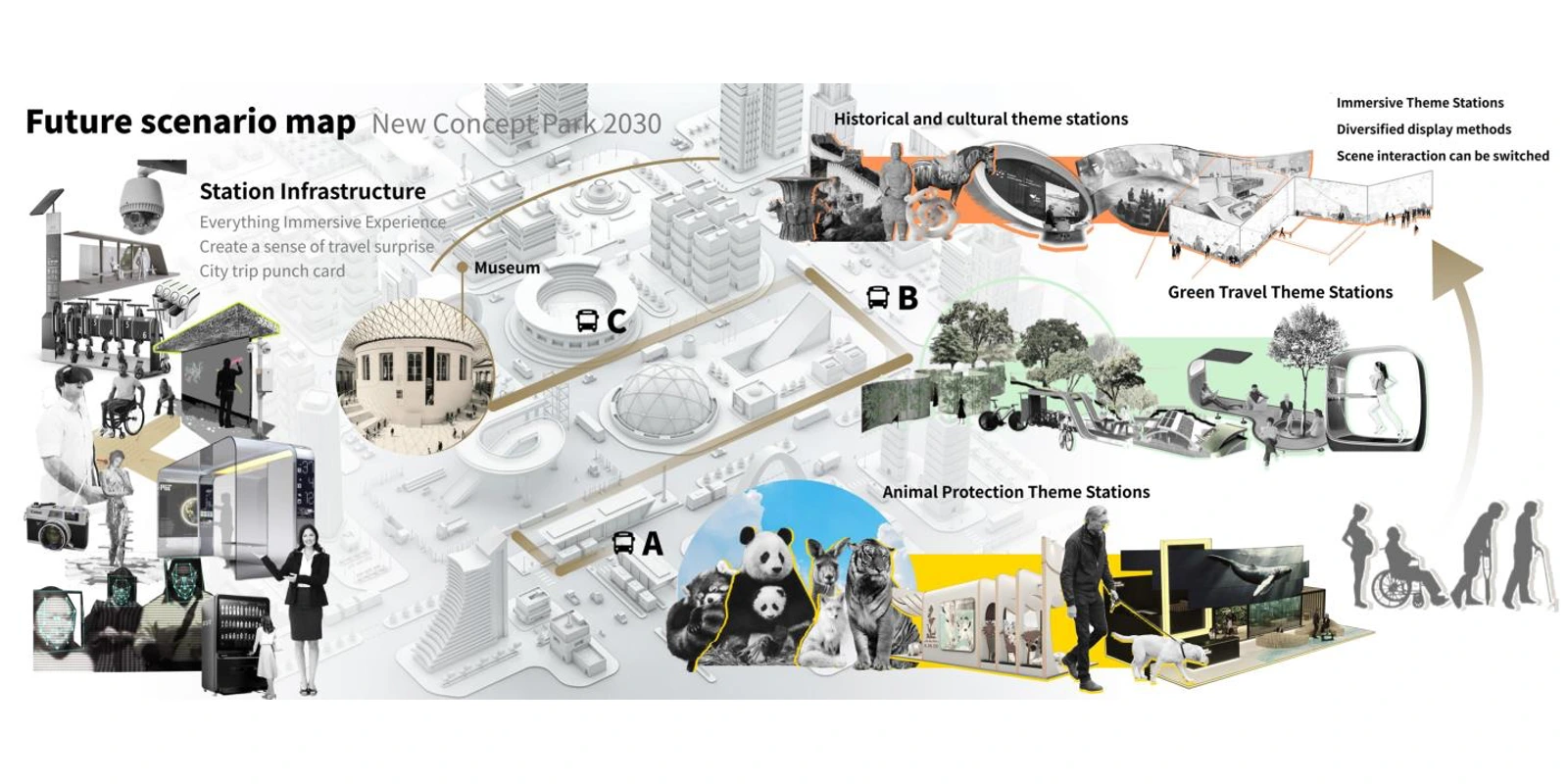
Station Group A illustrates how system exploration can develop into a service and spatial proposition. Instead of treating the station only as a place to board, the team connected mobility with historical and cultural experiences, green travel, animal protection and inclusive access.
From a vision to relationships
The ecosystem map links the station to service providers, suppliers, public authorities, residents and passengers. It exposes the relationships a richer station experience would depend on, rather than treating each proposed feature as self-contained.
From relationships to a spatial proposal
The team separated a waiting area from an area for additional services and interaction. The proposal includes resting and wayfinding alongside themed displays and activities; the drawings translate the scenario into spatial arrangements and touchpoints.
My teaching contribution was to help the team connect this vision to its earlier stakeholder and system exploration, question isolated ideas, and strengthen relationships among services, spaces, technologies and users. The student artefacts show that translation; they do not establish the proposal’s performance in a real transport system.
A contrasting future: making an experience legible
Station Group B explored a more distant future, with different assumptions about the environment, community life and technology. Its storyboard follows a person through finding a station, entering, boarding, travelling and using additional services.
In a teaching context, a sequence makes it possible to ask where information is needed, which actions the system assumes, and how the person understands what happens next. The work is shown as a speculative student proposal, not a prediction or an implemented HMI. Group A and Group B are alternative explorations, not successive versions of one design.
What the work reveals about learning
The selected work makes three aspects of the learning process visible: students connected multiple actors within a system, used scenarios to question the conventional station, and translated those investigations into spatial, service and interaction opportunities.
The publications add a second perspective. The Sustainability study collected questionnaires from all 28 participants in the documented round; the Applied Sciences paper reports interviews with five participants. Their feedback discusses the usefulness of role exploration and mapping, alongside difficulties with backcasting and the knowledge needed to reason across a complex system.
That is reflective feedback, not evidence of a measured learning gain or a controlled comparison between teaching methods. The proposals also remain outside a real shuttle deployment, limiting what can be concluded about their practical effectiveness.
For me, the central teaching lesson was that future-oriented work becomes more coherent when imagination has a visible foundation. System maps provide that foundation; tutorials and reviews help students return to it as their ideas develop.
In a future iteration, I would make intended learning outcomes and review criteria more explicit from the outset, and add a structured peer-critique session between scenario development and service ideation. This would help students examine each other’s assumptions before investing in a polished final proposal.
Teaching, student authorship and related research
This page presents my teaching assistance and co-facilitation, not sole authorship of the course or its student designs. The framework is teaching-team work; maps, sketches, storyboards, interfaces and renders are credited to their respective student teams.
The related research was developed collaboratively with colleagues at Politecnico di Milano. The papers acknowledge Professor Xiaofeng Xie’s support at Shandong University. My publication contributions include investigation and writing, and, in the Applied Sciences paper, methodology and formal analysis; these research credits are distinct from authorship of student work.
Related publications
Yan, M., Lin, Z., Lu, P., Wang, M., Rampino, L., & Caruso, G. (2023). Speculative Exploration on Future Sustainable Human-Machine Interface Design in Automated Shuttle Buses. Sustainability, 15(6), 5497. https://doi.org/10.3390/su15065497
Yan, M., Lu, P., Arquilla, V., Brevi, F., Rampino, L., & Caruso, G. (2023). Systemic Design Strategies for Shaping the Future of Automated Shuttle Buses. Applied Sciences, 13(21), 11767. https://doi.org/10.3390/app132111767
Image and source credits
Adapted from the supplied teaching portfolio and the two publications above. Published figures are reproduced or cropped under the articles’ CC BY 4.0 licences; captions identify the student group and source figure. The teaching-process diagram is the supplied portfolio’s simplified redraw of the teaching team’s framework. Student collages may incorporate reference imagery; neither those components nor the student proposals are presented as my individual design work.
Continue exploring
MuSynk

Solo product design and development: cross-device workflow, Android listening experience, macOS sync companion, and listening-history integration.
PDFclip 2

Independent product design and AI-assisted development, primarily with WorkBuddy: reading workflow, interface decisions, and iterative refinement.